










Talk Radio Blasts Baltimore City Pro-PLA Special Interest Legislation

Mike Henderson, president of ABC Baltimore, today appeared on the Sean & Frank program on Baltimore’s WCBM-AM (680 AM) to discuss legislation that will be introduced before the Baltimore City Council March 22 that would require “community partnership agreements” on city projects with a total cost of $5 million or more.

  • Listen to the radio interview here
  • Here is a draft of the legislation.

A community partnership agreement, of course, is just Big Labor’s way of rebranding project labor agreements (PLAs). This effort is nothing more than a public relations gimmick designed to confuse the public about the true intent of this legislation, which is to leverage cronyism government relationships to pass legislation that favors Big Labor by cutting competition from qualified nonunion contractors and their local nonunion employees.

Big Labor’s rebranding effort is simply putting lipstick on the PLA pig.

Meet Ms. Porkzilla, the Project Labor Agreement (PLA) Pig

Meet Ms. Porkzilla, the Project Labor Agreement (PLA) Pig

TheTruthAboutPLAs.com has blogged about this legislation (”Baltimore to Review Project Labor Agreement Law,” 3/9/10) and strongly opposes this special interest agreement that denies taxpayers and residents the accountability they deserve from the government.

TheTruthAboutPLAs.com especially opposes the disingenuous arguments Big Labor is using to lobby elected officials that this legislation will create jobs for Baltimore residents.

Under the measure, labor groups would be required to “exert their best efforts” to recruit city residents into union apprenticeship programs and hiring halls.  Best efforts don’t cut it, especially with construction unemployment hovering at 27 percent, as there is little chance that new recruits will benefit from jobs anytime in the near future because existing union members and apprentices have seniority and will be the first work.

What about current union members that are Baltimore residents that would allegedly benefit from PLAs?

Baltimore-area construction labor unions have not turned over any data documenting the demographics of their existing membership.  Just how many construction union members reside in Baltimore, how old are they, and what race and gender are they?

Big Labor attempted a similar “PLAs mean local hire” campaign when it secured a PLA on the Philadelphia Convention Center.  A Philadelphia Inquirer investigative reporter poured through government data on city public works projects and found that most construction union members lived outside of Philadelphia and were male, pale and stale. (Learn more here). So arguments that a PLA creates local hiring proved to be nothing more than a ruse in Philadelphia.

The same is true for Baltimore.

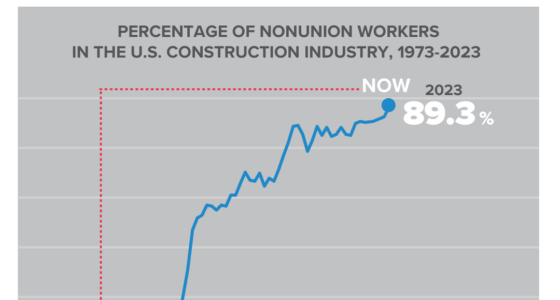
With just 12.6 percent of the Maryland private construction workforce belonging to a union, according to www.unionstats.com, Baltimore-area construction labor unions don’t have the manpower to build all of Baltimore’s construction projects. Union members will be imported from Washington, D.C., Delaware and Pennsylvania ahead of local and skilled nonunion employees from Baltimore and Maryland.

If politicians are looking out for the best interests of their constituents, it’s important to remember that in the end, taxpayers foot the bill for the added costs associated with anti-competitive PLAs. For example, studies of school construction in three states with prevailing wage laws demonstrate that PLAs increase the cost of school construction between 12 percent and 18 percent, when compared to projects built free of PLAs that were subject to the same prevailing wage laws. 

Can Baltimore really afford to build four schools for the price of five? Can it afford to create jobs for union members (some of whom will be non-local) ahead of skilled local nonunion employees? Can it afford to flirt with distorting the principles of free and open competition? Why not let a fair and competitive bidding process determine which businesses and employees can deliver the best possible product at the best possible price?

This legislation is nothing more than a sop to Big Labor and it should be rejected by the Baltimore City Council.

Gov. Culver Delivers for Big Labor

In what should be no surprise to anyone, Gov. Chet Culver announced today that the Iowa Department of Administrative Services has been approved to move forward with wasteful and discriminatory project labor agreements (PLAs) on two upcoming projects for the Department of Corrections.

Here is the text of Gov. Culver’s release announcing the PLAs:

Gov. Culver: Welcomes project labor agreements for new construction

3/16/2010

Contact:

Erin Seidler, Governor’s Office

(515) 281.0173

erin.seidler@iowa.gov

Signs letter to use PLAs for two major Dept. of Corrections projects

DES MOINES – Governor Chet Culver today accepted the recommendation by Department of Administrative Services Director Ray Walton to use Project Labor Agreements (PLAs) for construction of two major projects for the Department of Corrections – the new Iowa State Penitentiary in Fort Madison and improvements to the Iowa Correctional Institute for Women in Mitchellville. The Governor signed a letter today to include as a specification in the bid packages for each project the PLA.

The decision follows Governor Culver’s Executive Order 22 that directs state agencies to consider using PLAs for construction projects exceeding $25 million.

“This agreement ensures Iowa workers are paid the wages and receive the benefits they deserve, while keeping these critical projects on time and budget,” said Governor Culver.

While PLAs are common practice by many other states and the federal government, this will mark the first time such a pact has been used for a State of Iowa project. In his recommendation letter to Governor Culver, DAS Director Walton related his extensive research of PLAs, interviews with several trades groups and extensive negotiations with the two trade councils – the Southeast Iowa Building and Construction Trades Council (SEIBCTC) and the Central Iowa Building and Construction Trades Council (CIBCTC) – that will be involved with the two projects.

John Baldwin, Director of the Iowa Department of Corrections, agreed that PLAs are the right fit for these massive projects.

“Prison construction presents unique challenges,” said Director Baldwin. “Hundreds of craftsmen will be on these jobs at the same time and it is imperative to have firm control of the building process. PLAs keep projects on time and on budget.”

In Fort Madison, the project will rebuild a prison originally completed in 1839. The project in Mitchellville, while not as extensive, is critical in that it is the only women-specific facility in the state and must provide for a wider range of offenders.

Work is scheduled to begin in Fort Madison in spring of 2010 with an estimated budget of $130.6 million. The facility in Mitchellville is budgeted at $68 million, with bid letting beginning in August 2010.

As mentioned in the release, the decision to use PLAs on these projects comes as a result of Gov. Culver’s Feb. 3  Executive Order 22, which encourages state agencies to consider PLAs on state construction projects over $25 million.

We knew that the Culver administration was considering PLAs for these projects just days after Executive Order 22 was put to paper.  As early as Feb. 16, less than two weeks after Executive Order 22 was issued, the Des Moines Register reported that PLAs would likely be used on these two prison projects.

Here is an excerpt from the Register’s Feb. 16 coverage of the Department of Correction’s preliminary decision to move forward with PLAs on the two prison projects (Our emphasis added):

“We are just starting to learn about this process,” Baldwin said in an interview. “But we will figure out what it is, get input from both sides, and try to craft a document that is sensitive to everybody.”

Apparently, “learning about this process” to “figure out what this is” didn’t include looking at the history of PLAs in Iowa or on prison projects in other states.

In 2002, the Polk County Board of Supervisors signed a PLA with the Central Iowa Building and Construction Trades Council for the Iowa Event Center project.  This project included a 17,000-seat arena and meeting and exhibit halls.  The Board of Supervisors claimed that the PLA was necessary to “keep the project on time, keep it on budget and complete it in a safe manner.”

A 2006 study by the Public Interest Institute, a nonpartisan, nonprofit research and educational institute in Mt. Pleasant, Iowa, found that the PLA failed on all three counts and created unnecessary burdens for local workers, taxpayers and businesses.

Here is an excerpt from the study:

One might think that completing a project on budget, on time and safely would be the goal for each and every construction project, but apparently the Polk County Board of Supervisors felt these goals could not be accomplished on the Iowa Events Center project without a project labor agreement.  Having been granted the PLA, was the Iowa Events Center completed on budget, on time and safely?  No.  Instead, workers were frozen out of the opportunity to work, businesses were not allowed to compete and the taxpayers were forced to pay even more for the Iowa Events Center construction because of the cost overruns of the project.  The project labor agreement for the Iowa Events Center project was an unnecessary burden on the workers, businesses and taxpayers of Iowa.

The failure of the Iowa Event Center PLA is just one of many examples of PLAs increasing construction costs for taxpayers and limiting opportunities for nonunion workers to compete for projects paid for by their own tax dollars.

It also turns out that the track record for PLAs on prison construction isn’t much better.  Over $800 million worth of prison construction work is currently being held up because Gov. Ed Rendell’s mandate that PLAs be used on these projects led to ridiculously inflated bids and litigation.

We want to take this opportunity to remind the governor that PLAs are nothing more than special interest handouts that deny taxpayers the accountability they deserve on public construction.  We urge the Culver administration to reconsider their decision to mandate wasteful and discriminatory PLAs on these projects.

Visit here for more information on Gov. Culver’s Executive Order 22.

Rendell Administration Love Affair With Big Labor Stalls Prison Construction Projects and Slows Job Growth for Pennsylvanians

There is renewed interest in the delayed construction of over $800 million worth of prison construction in Pennsylvania.

As regular readers of TheTruthAboutPLAs.com remember, Gov. Ed Rendell (D) promised the Pennsylvania construction unions in 2008 that the Department of General Services (DGS) would require contractors to sign wasteful and discriminatory project labor agreements (PLAs) in order to work on over $800 million in upcoming state correctional institution construction.

This promise was a condition of a sweetheart deal between Rendell and the powerful Pennsylvania Building and Construction Trade Council, in which the council promised to support the prison construction appropriation through the state legislature in exchange for government-mandated PLAs on the prison work.

Fast forward to March 2010, despite a significant public relations campaign, a serious legislative inquiry and ridiculously inflated initial bids, the Rendell administration is still fighting to keep their handout to Big Labor attached to the projects.

Save the Endangered Species Billboard

Here’s an excerpt from a Pittsburgh Post-Gazette article (“Dispute Between Three Builders Delays Prisons,” 3/14) describing the situation:

State officials wanted to start work months ago on the first of three new prisons to ease crowding in the corrections system, a problem that has forced 2,000 inmates to be shipped out of state.

But a groundbreaking date for the first new State Correctional Institution, to be built in Centre County, is still not known, and a major reason can be summed up in three words — Project Labor Agreement.

Rendell administration officials and labor unions favor PLAs, but nonunion builders don’t, and the competition between union and nonunion builders for the lucrative prison construction work has been fierce.

In 2008, Democratic Gov. Ed Rendell’s administration signed a deal with union contractors to use PLAs to build the new prisons. The first prison — SCI Benner, to be located in Benner Township near the existing SCI Rockview — will cost about $200 million and hold 2,000 inmates.

A second new prison will be twice that size — holding 4,000 inmates and costing about $400 million. It will be built near the aging SCI Graterford in suburban Philadelphia and will be the new home for its 3,700 inmates. The current prison is to be emptied and mothballed.

Though the Benner and Graterford projects are months late in getting under way, the state now hopes to award contracts for them this spring and break ground this summer.

A third new prison, holding 2,000 prisoners and also costing about $200 million, is to go in Fayette County, at a site still to be announced. The goal is to have that project under way late this year, with all three prisons to be completed in about three years.

Although the Corrections Department operates the state’s system of 27 prisons, the three construction projects are being handled by the Department of General Services, which has been tangling with a group of nonunion contractors over the labor agreements since last summer.

General Services agreed two years ago with a group of politically powerful labor unions — the Pennsylvania Building and Construction Trades Council — to use the agreements for the prisons.

Construction “will require that labor organizations affiliated with the Building Trades will be the exclusive bargaining agents for all construction labor trades and crafts workers on each such project,” states a letter signed in April 2008 by James Creedon, secretary of the Department of General Services and a Rendell appointee, and Frank Sirianni, president of the state Building and Construction Trades Council.

Despite the obvious need to get this construction underway, both due to prison overcrowding and to help with the staggering unemployment in the construction industry, the Rendell administration continues to insist that PLAs need to be utilized on these projects.

Here is a second excerpt from the Post-Gazette article:

The request for an injunction to stop the Benner project ended in August when the state rejected all six proposals it had received because all of them were too high — meaning they exceeded the $200 million budgeted for the work.

But legal wrangling resumed in September when General Services sought bids for the new Graterford prison. Nonunion firms again sued over the PLA requirement but this time, Judge Pellegrini ruled in the state’s favor, denying the plaintiffs’ request for an injunction to stop the project.

In his ruling, he said, “The public would be harmed” if he granted the injunction because it would delay efforts to ease overcrowded and possibly dangerous conditions in state prisons. The decision is being appealed to the state Supreme Court.

The Benner project now has been delayed for nine months. Mr. Creedon said it’s ironic that with hundreds of construction workers out of work, the opponents of the labor agreements have prevented the prison projects from getting started and putting people to work.

New Benner construction proposals were sought last week and a contract could be awarded by early May.

“We can’t wait around any longer,” Mr. Creedon said, adding that he hoped the Benner prison work would begin by early summer.

PLAs won’t be mandated this time for the Benner prison, a decision that Diane Tokarsky, a lawyer for nonunion builders, called “encouraging.”

However, a PLA will be required when the new bids are sought for the Graterford prison project this spring, said General Services spokesman Ed Myslewicz. The department will do so because it has a court decision affirming the use of the agreement for that project, he said.

This is just another example of PLAs as political payback to Big Labor at the expense of the taxpayers.

The Engineering News-Record (ENR) also covered this story through a reprint of the Pittsburgh Post-Gazette article available here.

California Water District Soaks Taxpayers with Sop to Big Labor

The Pasadena Sun-Times is reporting that the the Upper San Gabriel Valley Municipal Water District has caved to Big Labor’s special interests and pledged to use PLAs on future construction projects (”San Gabriel water district gives big win to organized labor,” 3/14).

Those projects are expected to include a $210 million water recycling plant and several multi-million dollar endeavors to extend pipeline throughout the district’s territory.

The nod to organized labor should help strengthen union support for an $11.1 billion water bond coming before voters in November, board member Charles Treviño said.

Specifically, the district’s board of directors voted 4-1 earlier this month to pass a resolution directing staff to use project labor agreements (PLAs) on public works construction projects.

The PLA measure was pushed by board member Charles Trevino and Ed Chavez.   It is time for ratepayers and citizens to hold those officials in favor of the discriminatory and costly PLA accountable.

Bill Robinson was the only dissenting vote.

Robinson said PLAs would result in future water projects costing ratepayers more. And he said state and federal laws already require contractors be paid prevailing wages and set other labor standards.

It’s clear board members cut a corrupt deal with Big Labor in order to get Big Labor behind the November $11.1 billion bond measure. While citizens of this water district likely need critical infrastructure improvements , it’s a shame they have to pay an additional 12 percent to 18 percent in construction costs via the PLA “upcharge” in order for politicians to feel comfortable that citizens are going to make the right choice to improve their community.

Alaska Governor Criticized About Inaction Against PLAs

An opinion piece by Dan Fagen of the Alaska Standard takes Alaska Governor Sean Parnell to task for not standing up against discriminatory and costly project labor agreements (PLAs) (”Parnell refuses to do the right thing,” 3/15)

There are times when something is so obviously wrong and immoral, that when a politician refuses to do something about it, you question their character.

Such is the case with Governor Sean Parnell and his refusal to do something about project labor agreements. Project labor agreements or PLA’s require non-union workers to pay cash to unions if they want to work on certain jobs.

For example, the recent contract signed between the city of Anchorage and the IBEW union requires all electricians who chose not to join the IBEW to give the IBEW cash if they want to do electrical work for the city.

Why would government force anyone to pay a politically connected organization cash just to get a job? The IBEW and its members have given a lot of campaign contributions to former Mayor Mark Begich and the controlling faction on the Anchorage Assembly. So When Begich and the Assembly approved the IBEW contract, they rewarded the union and its members for donating to them by requiring non-union electricians to pay the union cash if those non-union workers want to do work for the city. There’s a word for all of this; extortion. Legalized extortion yes. But extortion nonetheless.

The fact that unions use politicians to discriminate and extort money from those to refuse to join their ranks is nothing new. Especially among Democrats. But the confusing part of all this is Sean Parnell. With a single signature, Parnell could issue an administrative order doing away with project labor agreements for state funded projects. Most of the projects the city is involved in are state funded.

20 other governors have banned project labor agreements. Tim Pawlenty of Minnesota being the latest example.

Why is Parnell refusing to sign an administrative order that would end extortion of workers refusing to join unions? His office, after repeated calls is refusing to say.

I have a suspicion. Mr. Parnell is more worried about getting elected than doing the right thing. He seems to want to avoid any controversy at any time. What does his refusal to do the right thing say about his character? It says everything.

To hear IBEW business manager Larry Bell and I in a heated debate over PLA’s, click on the audio link below to hear his call to my show on Friday.

Here at TheTruthAboutPLAs.com, we urge Gov. Parnell to do the right thing and issue an executive order prohibiting PLAs on state-funded construction. An order like this shows Alaskans that the governor is serious about quality and accountability on taxpayer-funded construction.

AGC Letter to the Editor Calls for Fair and Open Competition on Lake Champlain Bridge

Another Albany Times Union letter to the editor (”Bid project for bridge both ways,” 3/15) refutes a March 6 letter to the editor that encourages the use of a controversial project labor agreement (PLA) on the Lake Champlain Crown Point Bridge (a PLA fight TheTruthAboutPLAs.com has covered here) by Robert J. Jones, business manager of the International Union of Operating Engineers Local 106.

Jeffrey J. Zogg, CEO of Associated General Contractors of NYS makes some compelling arguments against Jones:

Of course there is a swift need for construction of this bridge. Nobody wants progress on this project more than we do. Contractors and their employees need the work.

A government-mandated project labor agreement was proposed by the building trades unions. PLAs are a highly controversial subject in the construction industry. Did they expect that wouldn’t be the case here?

Yes, prevailing wages will be paid on this work. They are required on all public work in New York and by law they are the union wage rates. Why then do we need a PLA?…

…Yes, all capable contractors can bid on PLA projects, but those who do not employ union labor usually don’t. The PLA precludes them from using most of their own long-standing employees. The unions argue that all can bid, when they know that most open shop bidders will not, which is really their goal.

Yes, this project should be built by skilled tradespeople from upstate New York and Vermont. But the PLA will deny those very local workers who are not unionized the opportunity. In the project region, there are more open shop workers than union workers. Which public official is going to tell them they can’t work on this project?

The best solution to ensure that all interested contractors can compete for the project, all available local workers can have the opportunity to work on it and the taxpayer can achieve the best price is to bid the project both ways. If the PLA is truly more economical, we will find out.

TheTruthAboutPLAs urges the NYSDOT to reject the special interest PLA on this project. Free and open competition will deliver the best construction product at the best price and create jobs for all construction employees, regardless of labor affiliation.

Another California County Poised to Prohibit PLAs, While the Riverside Community College District Trustees Can’t Help Themselves

Following the lead of Orange and San Diego Counties, the Riverside County Board of Supervisors is poised to take up an ordinance that would prohibit wasteful and discriminatory project labor agreements (PLAs) on county construction projects. If adopted, three of the four most populous counties in California will have said no to political handouts, and yes to accountability on taxpayer-funded construction projects.

The Riverside Board of Supervisors will consider this proposal tomorrow, March 16 at their 9 am PT meeting at 4080 Lemon Street, 1st Floor, Riverside, CA 92501. Please plan to attend the meeting and show your support if you are in the area.

You can also email members of the Board of Supervisors to show your support.  The Supervisors can be reached at:

While the Riverside County Board of Supervisors is considering the best way to ensure quality, accountability and results for their constituents, the Riverside Community College District Board of Trustees may do the opposite just hours later.

The trustees are scheduled Tuesday, March 16 to consider whether to require PLAs on the funds remaining from the voter-approved $350 million Proposition C.

As TheTruthAboutPLAs.com readers remember, the Riverside Community College District trustees voted during their December 15, 2009 meeting to require the college’s chancellor to negotiate a PLA with local labor unions and present it to the Board of Trustees for their approval.

The Riverside, CA Press-Enterprise had some thoughts on how this vote occurred in their editorial, “Shameful Vote,” (12/22/09):

The Riverside Community College District board’s new motto is apparently: Vote quickly, not carefully. The board pushed ahead with a sweeping new labor agreement last week, without giving the public — or even board members — a chance to understand the issue before the vote.

That nonsense needs to end. The district needs to provide thorough answers to the questions surrounding this pact before taking any further action. District officials need to explain the reason for the agreement, how the district and taxpayers might benefit from it and what effect the pact would have on the cost of college projects built with local bond money.

Seldom has a board decision raised more warning flags than last week’s vote on a draft project labor agreement with the Riverside and San Bernardino Building and Construction Trades Council. The board voted 3-2 to approve the draft pact and have Chancellor Greg Gray negotiate a final deal. The agreement would set workplace and contracting rules for all district projects of more than $1 million that use money from Measure C, the $350 million bond measure district voters approved in 2004.

But the circumstances surrounding the vote last week defy any conception of proper public procedure. The board received the document only minutes before the meeting began, so neither the trustees nor the public had any time to digest the draft pact before the board voted. Voting blindly is just reckless policy, particularly on an issue as far-reaching as the proposed labor pact.

The board could not hold any informed discussion on the document under those circumstances. But providing information was not high on the agenda: The district offered no analysis of how the agreement would affect college projects.

That omission is astounding. Such agreements almost universally favor expensive union workers over cheaper nonunion labor. So the pact could inflate the costs of college projects, thus reducing what the bond money will buy for students and the community. And district taxpayers will certainly want to know why a majority of the board is intent on rushing ahead without studying the financial consequences of the pact.

But when Trustees Virginia Blumenthal and Janet Green asked for more time to study the issue — and actually read the draft agreement — the rest of the board rebuffed the request. Just why is this deal so urgent to Mary Figueroa, Jose Medina and Mark Takano that they cannot spare time to answer questions about the consequences for the district?

The final agreement is slated to return to the board for approval in coming months. The chancellor and board will need to provide a clear rationale for the agreement, along with a detailed analysis of the pact’s provisions. And the board should allow a full public airing of those issues before it takes any vote.

Complete transparency is the only acceptable course. The reasons for this proposal remain unclear. But acting in haste, without public input, invites the suspicion that district taxpayers’ interests are not the trustees’ primary concern.

Here at TheTruthAboutPLAs.com, we encourage readers to reach out to the Riverside Community College District Board of Trustees and tell them to protect local taxpayers and say NO to PLAs.

Trustees can be reached at the following email addresses:

Riverside Press-Enterprise Editorial Calls PLA a Labor Giveaway

The editorial board of the Riverside Press-Enterprise is correct again with their latest editorial opposing the Riverside Community College District project labor agreement (PLA) that is on tonight’s agenda (”Labor Giveaway,” 3/15/10).

The Riverside Community College District has a public duty to protect taxpayers’ $350 million investment in new facilities. That duty requires the district to seek the best deal on new construction, not give labor unions an effective monopoly on the work.

The district Board of Trustees should reject the “project labor agreement” on the agenda tonight. Instead, the district should opt for a truly competitive bidding process that seeks the best value for public construction dollars. District voters approved Measure C in 2004 to renovate aging buildings and provide room for expansion, not so that board members could hand favors to union supporters.

The agreement between the college district and labor unions would cover all construction projects of more than $1 million financed by Measure C. The pact would basically force all contractors — union and nonunion alike — to follow union rules and pay union fees and benefits. The goal is to wipe out any competitive advantage nonunion construction firms might have.

That approach serves union interests at the public’s expense. The bidding process for the jobs cannot be truly competitive when the rules are slanted to favor union companies — usually the highest-priced labor around. Why should the district want an agreement that stands to inflate the cost of new construction? Furthering a union agenda comes nowhere close to meeting trustees’ responsibility to spend tax money wisely.

The Union Membership and Coverage Database, built on federal statistics, finds that only about 18 percent of California private-sector construction workers were covered by union contracts in 2009. What sense is there in the college district excluding companies that compose four-fifths of the state’s construction labor force?

The pact says that the provisions would help avoid work stoppages or delays. But the only real threat of work stoppages comes from the unions themselves. The agreement is a promise by the unions not to cause trouble if the district plays by labor’s rules — a thinly disguised form of blackmail, not a means of public-spirited cooperation.

The agreement also proposes to encourage the use of local businesses and workers. Yet pursuing that goal hardly requires the district to approve a labor pact.

And the district’s handling of the project agreement only adds to the suspicion surrounding the document. A majority of the board voted to push ahead with the pact in December, with little time for debate or public scrutiny and no analysis of the consequences.

And now the final agreement is back before the board — and still lacks any report analyzing how much the deal might cost the public, how it might affect district construction plans or what benefits the pact could offer taxpayers. Those basic details should be at the center of the discussion. Instead, they are not available to the public before tonight’s meeting — assuming the district has even compiled such information.

Trustees would be smart to discard the labor agreement. The pact does not represent good policy or sound oversight of public money. And taxpayers should ask the crucial question about any board members who do vote for this deal: Just who are those officials representing, anyway?

TheTruthAboutPLAs.com agrees and encourage readers to reach out to the Riverside Community College District Board of Trustees at the following email addresses and tell them to protect local taxpayers and say NO to PLAs:

Required Reading on Multi-Employer Pension Plan Crisis

Here is some required reading about Taft-Hartley plans and the problems facing multi-employer pension plans (MEPPs) by Frances Denmark at the Institutional Investor.

Readers can keyword search “pensions” to review the numerous posts TheTruthAboutPLAs.com has written about the link between government-mandated project labor agreements (PLAs) and MEPPs.

Key blog posts:

As we have stated many times at TheTruthAboutPLAs.com, one of the reasons nonunion contractors are discouraged from competing for contracts on construction projects subject to PLAs is because of typical provisions in a PLA that require employers to pay employee benefits into Big Labor’s MEPPs for the life of a PLA project.

In rare instances where nonunion employees (and union employees who do not belong to unions that are favored in PLAs) and their employers participate in PLA projects, employers must make benefit contributions to Big Labor’s MEPPs on behalf of employees. These benefit contributions are forfeited to the MEPP unless employees join a union and meet vesting schedules defined in by each plan.

An October 2009 report by Dr. John R. McGowan, “The Discriminatory Impact of Union Fringe Benefit Requirements on Nonunion Workers Under Government-Mandated Project Labor Agreements,” finds that employees of nonunion contractors that are forced to perform under government-mandated PLAs suffer a reduction in their take-home pay that is conservatively estimated at 20 percent.

Besides stealing benefits rightfully earned by construction employees working on a PLA project, a PLA’s pension provision is a windfall for Big Labor’s MEPPs because the MEPPS don’t have to pay future benefits to those employees. It props up these insolvent MEPPs and hides the flawed structure and Ponzi-scheme economics of MEPPs.

The Institutional Investor articles agree that calling MEPPs a Ponzi Scheme isn’t hyperbole and neither does the evidence.

Data from Moody’s Global Corporate Finance September 10, 2009 report, “Growing Multiemployer Pension Funding Shortfall is an Increasing Credit Concern,” measures the crisis faced by construction industry MEPPs.

Using 2007 numbers as a starting point, Moody’s estimates that 2008 underfundings for construction MEPP’s ballooned to $72.484 billion or a 54 percent funded level. In other words for every dollar that these construction MEPPs owe, they hold only 54 cents of invested assets.

Not good. And with unemployment in the construction industry at 27 percent, employers (usually union contractors) that participate in these MEPPs are going out of business. And when MEPP participants go belly up, the burden on employers remaining in the MEPPs becomes greater. Bankrupt contractors that can’t pay their fair share to MEPPs creates additional liability for a MEPPS remaining employer participants, which can prevent contractors from securing the bonding needed to build projects. This will force more employers out of business, which contributes to the negative feedback loop perpetuated by the flawed structure of MEPPs.

Is there any doubt why nonunion contractors avoid participating in MEPPs? Is there any doubt why nonunion employees would rather remain nonunion and participate in 401(k) and Roth IRA retirement plans than join a union and rely on MEPPs?

With the economic downturn, decline in construction industry union membership and looming demographic problems that  point to MEPP insolvency, how much money do you think it will cost the U.S. Pension Benefit Guaranty Corporation (PGBC) or taxpayers to bailout construction industry MEPPs? $125 billion? $150 billion? $200 billion? And will a bailout provide a long term solution or is it just a short term delay of the inevitable failure of MEPPs?

This MEPP crisis calls into question the wisdom of President Obama encouraging federal agencies to require PLAs on federal construction projects costing more than $25 million via Executive Order 13502. (Learn more about the status of the final regulatory rule implementing Executive Order 13502 here.)

Comments and thoughts are welcome.

Contractor Says PLA Would Be Business Suicide

A March 12 Albany Times Union letter to the editor refutes a March 6 letter to the editor that encourages the use of a controversial project labor agreement (PLA) on the Lake Champlain Crown Point Bridge (a PLA fight TheTruthAboutPLAs.com has covered here) by Robert J. Jones, business manager of the International Union of Operating Engineers Local 106.

Richard Piasecki, President of the Castelton, NY Piasecki Steel Construction Corp. says “a PLA would be business suicide” and explains what a PLA would mean to his business and his employees.

“Robert J. Jones’ March 6 letter about the Associated General Contractors’ position on a project labor deal for the Crown Point Bridge is a self-serving half-truth.

My firm is one of many upstate open shop bridge construction companies. All our employees are New York residents. Jones is technically correct that a nonunion firm like ours could bid under a PLA. It is also technically correct that we could shoot ourselves in the foot.

A project labor agreement forbids us from using our own personnel and forces us to hire exclusively union labor, from whom we can expect little loyalty and more than a little militant animosity.

For firms like us to bid on a PLA would be business suicide. My employees as taxpaying state residents deeply resent being precluded from any public work employment opportunity based on union membership.

If this PLA is such an economic benefit, let’s have it as a bidding option. Let’s all see these supposed benefits in black and white when the bids are opened.”

Mr. Piasecki touches on one of the key issues at the heart of the PLA debate. PLA proponents like Big Labor representative Mr. Jones are afraid to compete in the free market, so they invent subjective reasons why a PLA will benefit the community and construction owners in their effort to obtain a virtual monopoly on a PLA construction project’s workforce.  Mr. Piasecki argues that if PLAs are so great and offer cost savings, why not prove it through competitive bidding?

When governments mandate a PLA, discriminatory and costly PLA provisions apply to all contractors, so those contractors that can offer the best possible product at the best possible price without a PLA never have the opportunity to prove it.  There is nothing wrong with contractors voluntarily entering into a PLA, but the government shouldn’t be tinkering with the competitive bidding process to reward special interests.

It’s good government suicide, too.

Home Get the Truth About Us Home Sign Up To Get Email Alerts About PLAs Send Us A Tip! Help Us Tell The Truth About This Critical Issue