










Get the Truth
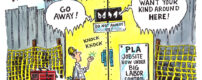
Anti-competitive government-mandated project labor agreements (PLAs) are special interest schemes that end open, fair and competitive bidding on taxpayer-funded construction projects.
Government-mandated PLAs discourage merit shop contractors from competing for and winning contracts for construction projects funded by taxpayer dollars. Construction contracts subject to government-mandated PLAs are almost always awarded exclusively to unionized contractors and their all-union workforces. Less competition and archaic and inefficient union work rules and featherbedding required by PLAs needlessly increase the cost of construction projects.
According to the most recent data from the U.S. Department of Labor’s Bureau of Labor Statistics, a record-low 10.3 % of the 2023 U.S. private construction workforce belonged to a union. This means PLAs, when mandated, discriminate against 9 out of 10 construction industry employees who want nothing more than to rebuild their communities at a price that is best for taxpayers but have chosen not to affiliate with a union.
The following provisions in PLAs typically discourage merit shop contractors from competing to win construction contracts subject to government-mandated PLAs:
- PLAs require merit shop companies to obtain most or all of their construction workers from union hiring halls. This means a merit shop company must use unfamiliar union workers on specific jobsites instead of their own skilled and experienced employees. In rare instances, merit shop employers can use a limited number of their own employees, but employers must send their nonunion employees to the union hiring hall and hope the union sends the same employees back to that specific PLA jobsite.
- Nonunion employees may have to pay union dues and fees and/or join a union in order to work on a PLA project, although these requirements can be less onerous in Right-to-Work states.
- Construction workers could suffer wage theft due to government-mandated PLAs as nonunion workers (and some union workers) lose an estimated 34% of wages and benefits earned on a PLA project unless they accept union representation, join a specific union, pay membership dues and meet the union benefits plan’s vesting requirements.
- Despite the fact contractors have their own benefits plans, PLAs require merit shop contractors to pay their workers’ health and retirement benefits to union benefit and pension funds. Thus, companies have to pay benefits twice: once to the union and once to the company plan.
- Paying into underfunded and mismanaged union pension plans can expose merit shop contractors to significant pension withdrawal liabilities, as documented in this Third Circuit legal case, for example. Signing a PLA and exposing a company to pension liabilities could bankrupt a contractor or prohibit contractors from qualifying for construction bonds needed to build future projects.
- PLAs require merit shop companies to obtain apprentices exclusively from union apprenticeship programs. Participants in federal and state-approved nonunion apprenticeship programs registered with the U.S. Department of Labor or equivalent state entities—as well as participants in non-registered industry and educational programs—typically cannot work on a job covered by a PLA. This means craft professionals enrolled in apprenticeship programs other than those offered by a union are excluded from work in their hometowns, choking off a viable and critical workforce development pipeline as the construction industry faces an estimated 439,000 person shortage of skilled labor in 2025.
- PLAs force contractors to follow inefficient and archaic work rules defined in the PLA and/or existing collective bargaining agreements for each trade on the jobsite incorporated into the PLA.
Learn more about the provisions in typical PLAs and how they harm nonunion contractors and employees at “Understanding Core Workforce Provisions in Project Labor Agreements” (4/7/14) and “Project Labor Agreement Basics: What Is a PLA?” (4/24/09).
PLAs drive up the cost of construction projects. By unnecessarily limiting competitive bidders and following outdated and inefficient union work rules, PLAs consistently and unnecessarily drive up costs on projects. Analysis of numerous academic studies of taxpayer-funded school construction and affordable housing projects already subject to prevailing wage laws indicate government-mandated PLA increase the cost of construction between 12% and 20% when compared to similar projects not subject to PLA mandates. Review the latest studies on PLA schemes via the BuildAmericaLocal.com website.
PLAs discriminate against merit shop contractors and disadvantaged businesses. This discrimination is particularly harmful to women- and minority-owned construction businesses—whose workers traditionally have been under-represented in unions in many markets, mainly due to artificial and societal barriers in union membership and union apprenticeship and training programs. Get the facts about the discriminatory impact of union-favoring PLAs on women- and minority-owned construction businesses and workers.
PLAs harm local workers. Proponents claim PLAs ensure the use of local workers, but the truth is PLAs take away jobs from local workers. PLA lobbyists fail to mention the term local workers excludes qualified local nonunion, women, minority and veteran construction workers employed by nonunion contractors excluded by PLA mandates. This rhetoric is particularly misleading because only 10.3% of U.S. construction workers belong to a union. In construction markets where the demand for union labor is greater than the supply, union workers from outside the local area are given preference over qualified local nonunion workers on PLA projects. These union workers are called travelers or boomers, and they take jobs away from local qualified nonunion craft employees. Anecdotal evidence in many areas of the country suggests that PLAs don’t result in better local hire outcomes.
PLAs take away employee’s rights. Employees normally are permitted to choose whether to join a union through a card check process or a federally supervised private ballot election. PLAs require unions to be the exclusive bargaining representative for workers during the life of the project. The decision to elect union representation is made by the employer —when agreeing to participate in a PLA—rather than the employees. PLAs are called pre-hire agreements because they can be negotiated before the contractor hires any employees or employees vote on union representation. The National Labor Relations Act (NLRA) generally prohibits pre-hire agreements, but an exception in the law allows for these agreements only in the construction industry. In short, government-mandated PLAs strip away the right of construction workers to a federally supervised private-ballot election or a card check election when deciding whether to unionize their workplace. PLAs can be less onerous on nonunion construction workers in Right to Work states but workers can be forced to pay agency shop fees to unions as a condition of employment in certain circumstances.
PLAs are not necessary to, and are not successful at, ensuring labor peace or keeping a project safe, on time, on budget, or in compliance with labor laws. Unions leverage the threat of labor strikes and unrest to compel construction users to require PLAs on construction projects. This is a particularly disingenuous argument that flirts with blackmail because unions cause many project delays through illegal organizing and jurisdictional disputes. In addition, construction unions have repeatedly struck on prominent PLA projects and strikes are increasingly rare in today’s construction industry, calling into question the value of the agreements. In contrast, merit shop workers do not strike, yet they are typically discouraged from working on PLA projects.
As documented in the following linked blog posts, government-mandated PLAs do not guarantee a safe jobsite, nor do PLA mandates ensure compliance with labor laws. Some courts have found PLA mandates violate state and federal competitive bidding laws. In fact, some unions and unionized contractors oppose PLA mandates.
A report by ABC general counsel Maury Baskin, Government-Mandated Project Labor Agreements: The Public Record of Poor Performance (2011 Edition), documents the numerous broken promises and mishaps on government-mandated PLA construction projects, such as the infamous Big Dig in Boston.
Additional research and studies on the cost and negative impact of government-mandated PLAs is available here.
To learn more about PLAs, contact the team at Associated Builders and Contractors or visit www.facebook.com/TheTruthAboutPLAs and @TruthAboutPLAs and leave us a note.